You Don’t Have To Love AI, Your Customers Are Using It Anyway
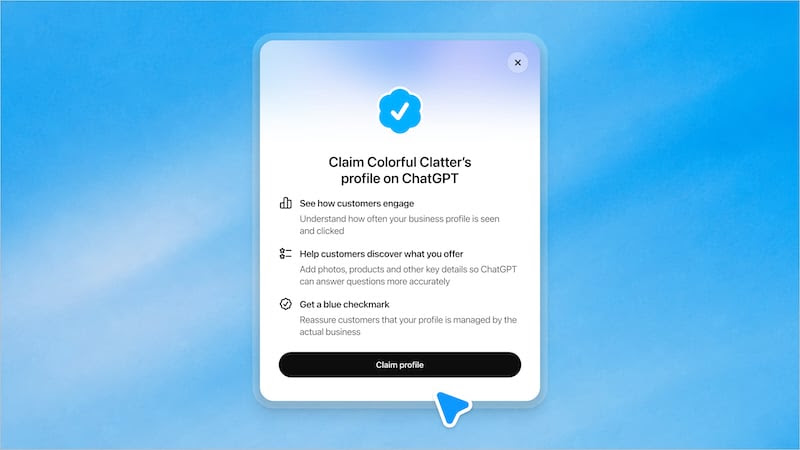

On Tuesday, OpenAI launched something a lot of business owners have been asking me about. It’s called Businesses in ChatGPT, and the simplest way to describe it is a Google Business Profile for AI.
They’re offering a new tool called Business Hub where you can claim your business, get a blue checkmark once you’re verified, and update the details ChatGPT uses when it talks about you, including prices and availability. You also get a dashboard showing how often ChatGPT has mentioned you, how many people clicked through to your website and what topics came up in those conversations. It’s in beta, it’s free for now, and OpenAI is clear that claiming your profile won’t get you better placement in its answers, but of course if it has more information about you, you’re more likely to get cited.
They say that if you have a physical location it’s only available in the US, but I was able to claim Junction’s so if you’re in Canada, it’s worth a try. Online businesses have more options, and it appears that if you only want to direct people to your website, that’s available to everyone.
But What About All of the Bad Stuff About AI?
Do I talk about AI a lot here? Sure.
Are there reasons to be concerned about AI? Definitely.
I’ve given this a lot of thought, and I’ll share a framework that has been helpful for me to think about the very real concerns about AI and how we can all choose to either use it or not.
First, there are real environmental and safety concerns. You’ve seen the doomsday stories, so you don’t need me to rehash them for you. But most of those concerns have been true of the tech industry for years (data centres, privacy, misinformation). AI is a heightened version of problems we’ve been living with for a while. The responsibility to regulate, and hold big tech accountable lives primarily at the government level, so the best way that we can make an impact is to vote, and to communicate our concerns to our leaders. Whether your business chooses to use the tools or not is not going to be noticed by Anthropic, OpenAI, etc.
Second, your customers are already using it. OpenAI says 1.2 billion people use ChatGPT every week, and this year nearly 50% of travellers will use some form of AI to plan their trips. Whatever we think of the tool, the least we can do for our guests is make sure we’re easy to find, and described accurately, when they ask.
Third, the big companies aren’t waiting. Large companies are using AI aggressively to cut costs, launch new products and move faster. Last week I mentioned Expedia building an AI agent that onboards new hotels in a fraction of the time it used to take. The gap between small and large businesses in this economy is already wide, and sitting on the sidelines will only make it wider.
Finally, used well, AI does the work we’re worst at. It shouldn’t replace what humans are uniquely qualified to do, like telling stories, serving customers, coming up with new ideas and leading our teams. It should free us up to do more of what we’re best at. The best use of it is clearing away the admin and busywork that keep us from doing more of that.
You don’t have to love AI to agree with any of that. You just have to accept that your customers are using it, and the opportunity to serve them better using this technology exists.
So What?
Here’s this week’s 15-minute job. Open ChatGPT, go to Business Hub (chatgpt.com/business-hub) and search for your business. If you can claim it, do it, then check every detail it shows, from your hours and prices to your website and description.
If you can’t claim it yet, ask ChatGPT (or Claude, Gemini, etc.) the questions your customers would ask, like “best family-friendly hotel in [your town]” or “things to do in [your town] this winter,” and write down what it says about you. If something’s wrong or missing, ask it where it’s getting its information, and fix it.
Then set a reminder to check again next month. AI answers change constantly, and it’s worth knowing what they say about you before your customers do.
You may also like: